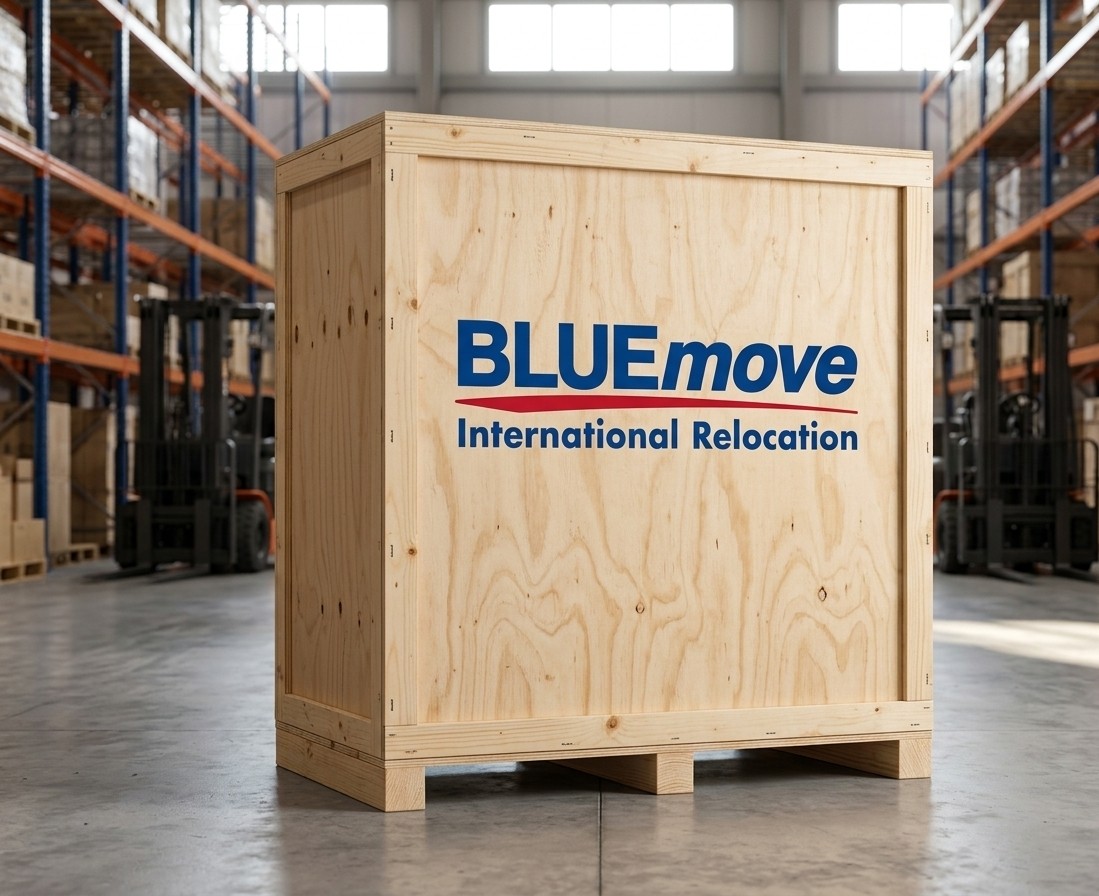
A liftvan is a sturdy wooden crate, packed with your household goods, sealed, then loaded into a shared ocean container alongside other households’ shipments. At destination, the crew unloads the crate, delivers it and unpacks it at your new home. It is the standard way to ship part of a home overseas without paying for a whole container.
If you’ve been gathering estimates and spotted the word “liftvan” on a survey or quote, you’re in the right place. Most people meet the term for the first time exactly that way: a surveyor walks through the house, and the estimate comes back priced in liftvans rather than pounds or boxes. Understanding what that unit represents is one of the fastest ways to make sense of competing estimates, which is also why it pays to compare international moving quotes on a like-for-like basis before you commit to anyone.
BLUEmove International Relocation has spent 21+ years packing, crating, consolidating and delivering household goods across oceans. Below is a plain-English guide to what a liftvan is, how it behaves in the real world, when it beats a sole-use container, and when it doesn’t.
What a Liftvan Is and How It Actually Moves
A liftvan (sometimes written “lift van” or called a wooden lift) is a purpose-built plywood crate on a reinforced timber base. The base is designed for forklift tines, which is where the name comes from: it is a van-sized box designed to be lifted rather than driven.
Here is the sequence, start to finish:
- Packing at origin. Our crew packs your goods into cartons at your home to export standard, with heavier paper, double-wall cartons for fragile items, and custom crating for artwork, mirrors and stone tops.
- Loading the liftvan. First, the crew loads the crate at your home where access allows, or at the origin warehouse where it doesn’t.
- Sealing and inventory. Then the lid goes on, the crew nails or bands the crate shut, and a numbered seal goes on.As a result, your inventory carries that seal number.
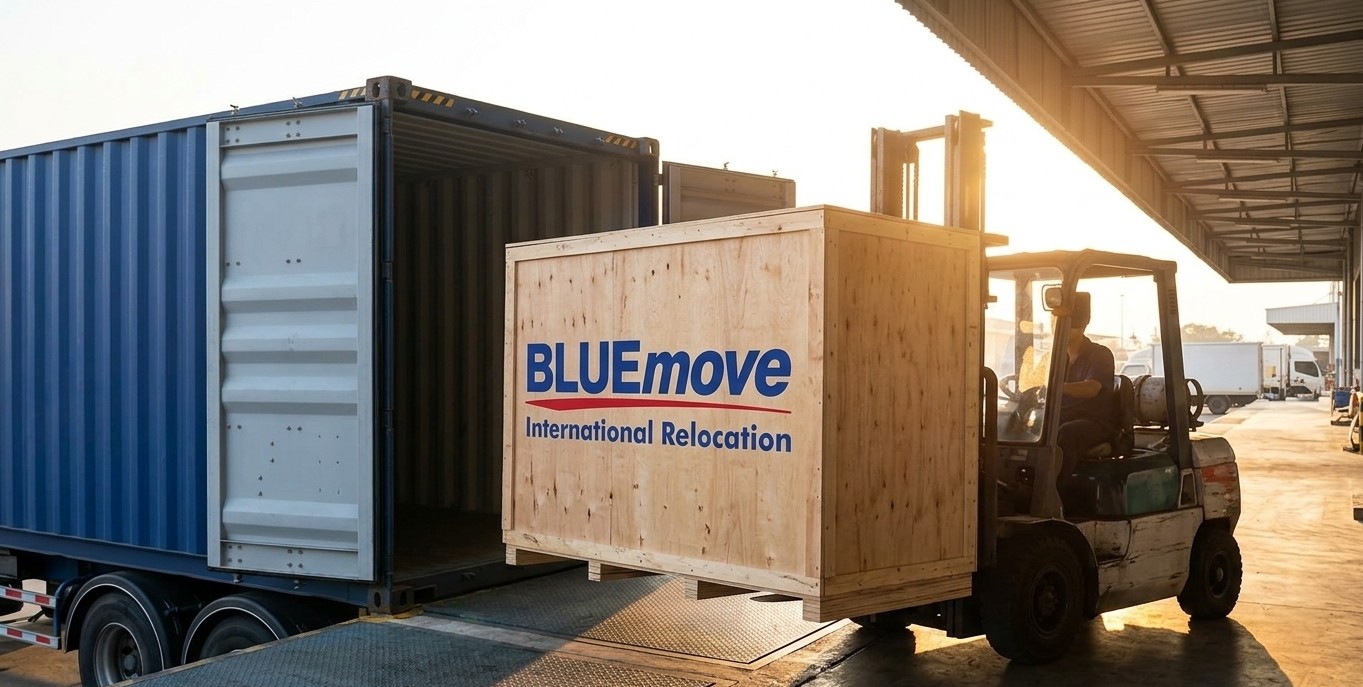
- Consolidation. After that, the sealed liftvan goes to a consolidation warehouse, where the team loads it into a 20ft or 40ft ocean container with other sealed liftvans heading to the same port. Nobody unpacks anything to do this.
- Ocean transit and destination handling. TThe container then sails, clears customs at destination and reaches a destination warehouse, and a truck takes your liftvan to your new address.
- Delivery and unpacking. Finally, the crew opens the crate at your home, carries the cartons in, reassembles the furniture and, if you’ve chosen a full unpack, empties the cartons and removes the debris.
That sealed-at-origin, opened-at-destination flow is the most important thing to understand about how to ship household goods overseas using shared container space. Your goods are not loose in a container with somebody else’s dining set. They are inside their own rigid, sealed box the entire way.
Liftvan vs LCL: Are They the Same Thing?
Not quite, and the distinction matters when you read quotes. LCL shipping (less than container load) is the commercial term for any shipment occupying part of a container rather than all of it. A liftvan is the LCL method most commonly used for household goods, because crating gives protection that loose palletized freight doesn’t.
Some providers quote LCL shipments palletized and shrink-wrapped instead of crated. That is cheaper to produce and more exposed to handling damage, and it often explains a very low per-cubic-foot number on an estimate. Ask directly: is my shipment crated in a liftvan, or wrapped on a pallet? A reputable mover will answer in one sentence. Our guide to the hidden costs of shared-container shipping covers the other line items that tend to hide behind an attractive headline rate.
Liftvan Dimensions and Capacity: What Fits Inside One
In general, liftvan sizes follow a common standard across the industry. A standard liftvan measures roughly 87 inches high by 87 inches long by 45 to 48 inches wide on the outside and holds about 180 cubic feet. Even so, sizes vary slightly between suppliers, and crews build custom crates when something won’t fit.
Cubic feet is a hard unit to picture, though. What people can picture is furniture, so here is a rough translation of what about 200 cubic feet looks like:
| About one liftvan | What that looks like in practice |
|---|---|
| A furnished bedroom | Bed, dresser, nightstands and the bedroom’s cartons |
| A home office | Desk, chair, bookcase, filing and cartons of books and papers |
| A dining room | Table, chairs, sideboard, china cartons |
| “Just the things we can’t replace” | Heirloom furniture, art, china and books: the classic partial move |
One practical note: liftvans have a fixed internal height, so tall or long items can force awkward decisions. For example, an eight-foot sectional, a full-size armoire, a grandfather clock or a long dining table may need to lie flat, come apart, or go into a separate custom crate. A surveyor spots this immediately. A phone estimate almost never does, which is one of several reasons we push for a proper survey on every international shipment.
Liftvan vs Sole-Use Container: The Real Comparison
This is the decision most readers are actually trying to make. Here is the side-by-side, without the sales gloss.
| Factor | Liftvan (shared container) | Sole-use container |
|---|---|---|
| Security | Crate sealed with a numbered seal recorded against your inventory. You share the container, but your goods stay enclosed. | Container sealed at your home, with only your goods inside. Highest chain-of-custody integrity. |
| Handling | More touchpoints: the crate is loaded, consolidated, unloaded and delivered. The rigid crate exists to absorb that. | Fewer touchpoints. Goods are loaded once and unloaded once. |
| Timing | Depends on consolidation: the container sails when it’s full or on a scheduled sailing, adding waiting time at both ends. | Books directly onto a sailing. Generally the faster option door to door. |
| Cost logic | You pay for the volume you actually use, typically quoted per cubic foot. | You pay for the container whether it’s full or not. Efficient only when you genuinely fill it. |
| Typical household size | Studios, one- and two-bedroom homes, partial shipments, students, downsizers, second-home setups. | Fully furnished three-bedroom-plus homes, or any move with bulky items and tight deadlines. |
| Access requirements | Modest. Crates are built and moved with a smaller truck and forklift. | Needs room for a 20ft or 40ft container and its truck, or a shuttle at extra cost. |
Now the question everyone asks: at what volume does a container become cheaper?
There is a crossover point, but treating it as a fixed number is a mistake. It moves with your trade lane, the season, current ocean freight rates, destination port charges, and how much of your volume is bulky but light rather than dense. Our breakdown of what international moving costs goes deeper into how those variables interact.
As a rough guide, if your surveyed volume is comfortably under half a 20ft container, liftvans usually win. If you’re clearly filling a 20ft container, book the container. In the grey zone in between, ask your mover to price both and show you the total landed cost, not just the ocean leg.
Where Sea and Air Fit In
Liftvans are a sea freight product. If timing is the main constraint, air freight moves in roughly 5 to 10 days against 4 to 8 weeks by sea, but it is priced by weight and suits a small, carefully chosen selection rather than a household. Plenty of our clients run a hybrid: a few air cartons with laptops, school uniforms, kitchen essentials and a few days of clothing, with the rest following in a liftvan. It takes a lot of stress out of the first two weeks abroad.
How Liftvans Show Up in Your International Movers Quote
Liftvan shipments are priced by volume. Shared container rates commonly land somewhere in the range of $8 to $25 per cubic foot, and that spread is wide for good reason: origin service level, trade lane, destination country charges and the amount of packing labor all move the number.
Because volume drives price, the survey drives everything. A surveyor walking your home, in person or by video, will count furniture, estimate carton volume room by room, flag items needing custom crates, check stair and doorway access, and note anything that can’t ship. Guessing at volume over the phone produces an estimate that changes on loading day, and nobody enjoys that conversation in a driveway with a crew standing by.
What’s Usually Inside the Price
- Export packing materials and labor
- Liftvan construction and loading
- Transfer to the consolidation warehouse and container loading
- Ocean freight and standard documentation
- Destination unloading, delivery to your residence, and basic placement
What’s Usually Outside the Price
This is where a low international movers quote can quietly become an expensive one. Watch for:
- Destination duties and taxes. Many countries grant relief on used household effects for returning residents or new immigrants, but eligibility rules, document requirements and deadlines vary enormously. Duty assessed on your shipment is a government charge, never a mover’s fee.
- Port storage and demurrage. If your paperwork isn’t ready when the vessel arrives, storage charges start running at the terminal. This is one of the most common surprise costs.
- Customs examinations. Random or targeted inspections generate handling charges that no mover can predict in advance.
- Insurance above basic liability. Standard carrier liability is not full-value protection. Our transit insurance options are priced separately, based on a valued inventory you prepare.
- Shuttle, long carry and stair charges at either end where access is restricted.
- Storage in transit if your new home isn’t ready.
Ask every mover to state these exclusions in writing. If one quote lists them plainly and another is silent, the silent one isn’t cheaper. It is just less complete. We have built our reputation on clear communication, and that starts at the estimate stage rather than at the invoice stage.
Verifying the Company Behind the Quote
Two credentials matter for a US-based ocean household goods move. BLUEmove International Relocation is FMC-registered (license 020452), which you can confirm directly on the Federal Maritime Commission website, and IAM-certified through the International Association of Movers. The first governs how ocean transportation intermediaries operate and protect your money; the second connects us to a vetted global agent network, so the crew at destination is held to the same standard as the crew at origin. Check both before you pay a deposit to anyone.
What Can’t Go in a Liftvan
Some of this is physics, some is law, and some is simply destination customs policy.
Vehicles
Cars, boats and ATVs cannot ship in a liftvan. An average car size is more than twice the length of a liftvan, and vehicles need different documentation and customs treatment. BLUEmove International Relocation ships vehicles by container only, either inside your household goods container or in a dedicated container. Our cargo and vehicle shipping page explains the process.
Hazardous and Prohibited Items
- Fuels, propane, kerosene, lighter fluid, and any pressurized canister
- Paints, thinners, solvents, adhesives, aerosols and pool chemicals
- Firearms and ammunition (heavily restricted, with a separate process where permitted at all)
- Fireworks, matches and flammable cleaning products
- Batteries and battery-powered devices beyond specific carrier limits
Perishables and Biosecurity Risks
Food, plants, seeds, soil and untreated wood products are restricted or banned in most destinations. Australia and New Zealand are particularly rigorous, but nearly every country now inspects for pests. Outdoor furniture, garden tools, bicycles and lawn equipment must be genuinely clean, free of soil and plant matter rather than just wiped down. A failed inspection means fumigation charges and delay.
Things That Simply Shouldn’t Ship
Passports, birth certificates, wills, deeds, prescription medication, jewelry, cash and irreplaceable small valuables should travel with you. If it would ruin your month to be without it for six weeks, it belongs in your suitcase.
How Many Liftvans Will My Home Need?
The simple rule: divide your surveyed volume by about 200 cubic feet. That gives you the number of liftvans, and it tells you which side of the liftvan-or-container line you are on.
| Home type | Likely method | Notes |
|---|---|---|
| Studio or one-bedroom | Liftvans | Books and kitchenware add volume faster than people expect |
| Two-bedroom apartment, furnished | Price both | The grey zone: compare liftvans and a 20ft container side by sider |
| Three+ bedroom house | Sole-use container | Usually the better economics and the faster route |
Two variables skew this more than anything else. First, garages, basements and attics: the storage spaces people forget to mention are often the biggest single contributor to volume. Second, decluttering: a genuinely ruthless sort-through before the survey can change which shipping method makes sense, and therefore what you pay. We would rather help you ship less than quietly ship more.
Who Liftvans Suit Best
Downsizing and retirement moves. Older clients relocating to be closer to family abroad, or settling into a smaller home overseas, rarely need a full container. Liftvans let them bring the furniture that matters, the heirloom dresser or the dining table that hosted forty Thanksgivings, without paying for empty space. These moves deserve extra time, because the pace and the reassurance matter as much as the logistics. Fragile collections, antique finishes and older upholstery all need careful handling, and generic packing doesn’t cut it.
Corporate assignees and diplomatic staff. Assignments from the Washington DC area often involve partly furnished housing at destination, which makes a partial shipment the natural fit. Liftvans also suit split consignments, with some volume shipping now and some following later. Serving the diplomatic and embassy community in the Washington DC area is one of our most established lanes.
Second-home owners and high-end partial moves. Furnishing a property abroad with selected pieces rather than a whole household is textbook liftvan work, particularly when art, mirrors and stone tops need individual crating inside the liftvan.
Students, early-career expats and trial relocations. If you’re not certain a country will stick, shipping a single liftvan is a far more sensible commitment than filling a container you may have to reverse in eighteen months.
Frequently Asked Questions
What is a liftvan?
A liftvan is a wooden crate on a forklift-ready timber base that is packed with your household goods, sealed with a numbered seal, and loaded into an ocean container alongside other sealed shipments. It travels as a single protected unit and is opened again at your destination residence. It is the most common way to ship part of a household overseas without paying for a full container.
How big is a liftvan?
A standard liftvan measures roughly 87 inches high by 87 inches long by 45 to 48 inches wide on the outside and holds about 180 cubic feet. Sizes vary slightly between suppliers, and custom crates are built for oversized items. Because crate height is fixed, tall or long items such as armoires, grandfather clocks and long sectionals may need disassembly or a separate custom crate, which a surveyor will spot on the walkthrough.
Is a liftvan cheaper than a container?
For smaller shipments, usually yes, because you pay for the volume you use rather than for a whole container. Shared container shipping commonly runs in the region of $8 to $25 per cubic foot, so the arithmetic favors liftvans while your volume stays modest. The crossover point is not a fixed figure. It shifts with trade lane, sailing schedules, ocean rates, destination charges and how bulky your goods are. If you are in the middle ground, ask for both options priced as total landed cost and decide on the full number, not the freight line alone.
How many liftvans do I need for a 3-bedroom house?
Divide your surveyed volume by about 180 cubic feet to estimate the number of liftvans. A fully furnished two-bedroom home usually sits at or beyond the point where a sole-use container becomes the better value and the faster option, and garage, basement and attic contents often push it over that line. The only reliable answer comes from a survey, in person or by video, and from there we will price both approaches so you can compare them side by side.
Let’s Figure Out the Right Option for Your Move
Choosing between a liftvan and a sole-use container isn’t really a freight decision. It is a decision about what you’re taking, when you need it, and what you’re comfortable spending, and it deserves a conversation rather than a template.
BLUEmove International Relocation has 21+ years of experience guiding families, retirees, corporate assignees and diplomatic staff through exactly this question. We are headquartered in Columbia, Maryland, serve the Washington DC area and move clients from anywhere in the USA, with an FMC-registered and IAM-certified global agent network handling the destination end. Full service means exactly that: survey, packing, crating, customs documentation, shipping, delivery and unpacking, coordinated by people who answer the phone when you call.
Every family gets a named coordinator who knows their move. We don’t just move boxes. We bring families home.
Request your free estimate or call us at 301-570-3306 to arrange a survey. We’ll price liftvans and a container side by side, spell out what’s included and what isn’t, and help you choose the option that fits.
Liftvans or a container: which fits your move?
BLUEmove International Relocation moves American families abroad door-to-door from Columbia, Maryland. FMC-registered, IAM-certified, 21+ years. We’ll price both options side by side so you can choose with the full picture.
What does an international move cost? · How to compare moving quotes · Prefer to talk? 301-570-3306